
1000 Square Feet Requires How Many Tiles
Clear beginner guide showing exactly how many tiles 1000 square feet needs for every common size, with the simple formula, 10% wastage rule, full comparison tables, two worked examples, and practical tips so you order the right quantity the first time.
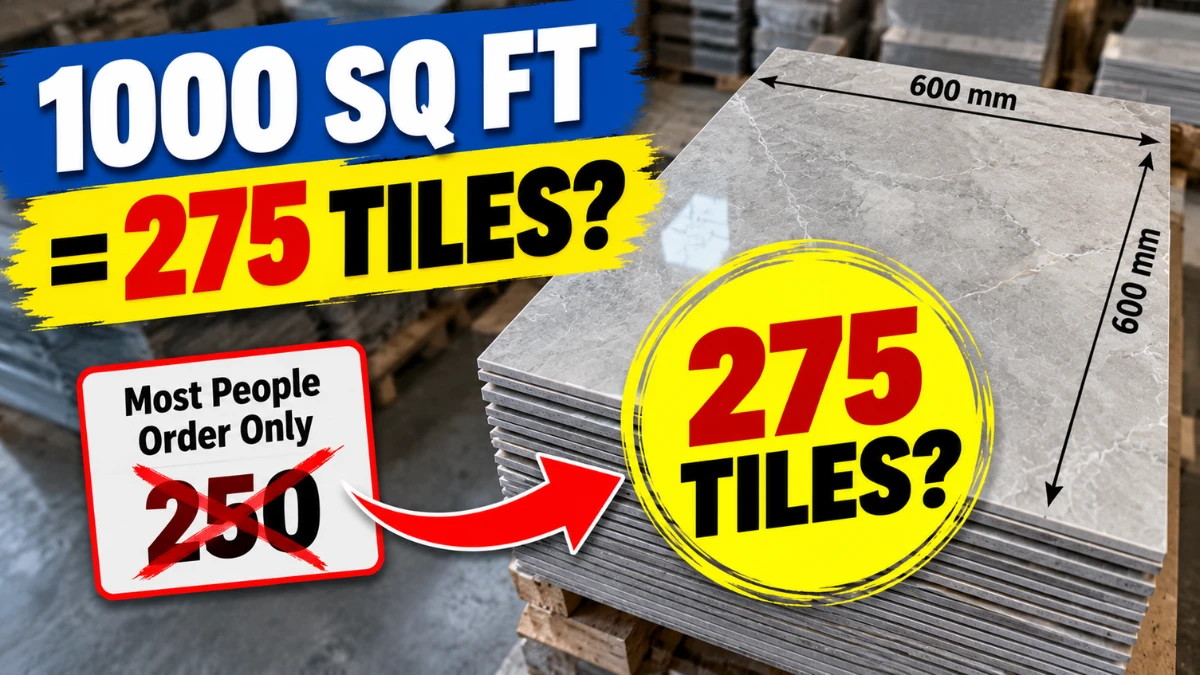
For a 1000 square feet area, the number of tiles you need equals 1000 divided by the area of one tile, then add 10% for wastage. A standard 2 ft × 2 ft (600 × 600 mm) tile covers 4 sq ft, so you need 250 tiles before wastage and 275 tiles after the 10% extra.
Most beginners stop at the basic division and later run short. The rest of this guide shows the exact formula, size-by-size tables, two full worked examples, and the common mistakes that force a second trip to the store.
Why the Exact Number Depends on Tile Size
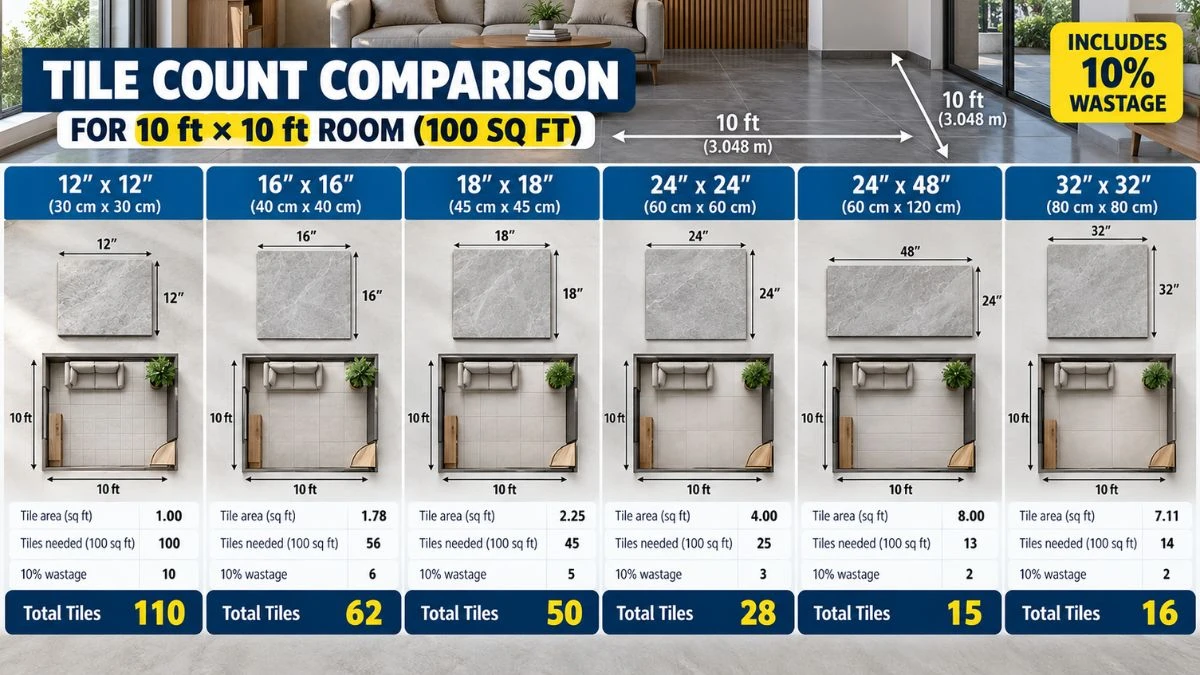
Tile size decides everything. Larger tiles cover more area with fewer pieces. Smaller tiles need more pieces and create more cuts.
In Indian homes the most common floor sizes are:
- 12 × 12 inch (300 × 300 mm) – 1 sq ft each
- 16 × 16 inch (400 × 400 mm) – about 1.78 sq ft each
- 18 × 18 inch (450 × 450 mm) – 2.25 sq ft each
- 24 × 24 inch (600 × 600 mm) – 4 sq ft each
- 24 × 48 inch (600 × 1200 mm) – 8 sq ft each
- 32 × 32 inch (800 × 800 mm) – about 6.94 sq ft each
Always measure your actual floor area first. Deduct permanent fixtures only if they will stay uncovered. Then apply the formula.
Simple Formula to Calculate Tiles for Any Area
- Measure length × width = total area in square feet.
- Find area of one tile (length × width of the tile in feet, or convert from mm).
- Base tiles = total area ÷ tile area.
- Add wastage (normally 10%).
- Round up to the next full box.
Formula in one line:
Tiles required = (Floor area ÷ Tile area) × 1.10
Round the final number up. Tiles are sold in full boxes, never partial.
Quick Reference Table Tiles Needed for 1000 Square Feet
| Tile Size (inches) | Tile Size (mm) | Area per Tile (sq ft) | Base Tiles (no wastage) | With 10% Wastage |
|---|---|---|---|---|
| 12 × 12 | 300 × 300 | 1.00 | 1000 | 1100 |
| 16 × 16 | 400 × 400 | 1.78 | 562 | 618 |
| 18 × 18 | 450 × 450 | 2.25 | 445 | 490 |
| 24 × 24 | 600 × 600 | 4.00 | 250 | 275 |
| 24 × 48 | 600 × 1200 | 8.00 | 125 | 138 |
| 32 × 32 | 800 × 800 | 6.94 | 144 | 158 |
These numbers assume a straight layout and rectangular room. Diagonal or herringbone patterns need 15% wastage instead of 10%.
Step by Step Calculation for 1000 Sq Ft with 2 × 2 Ft Tiles
This is the size most people choose for living rooms and bedrooms in India.
- Tile size = 2 ft × 2 ft
- Area of one tile = 4 sq ft
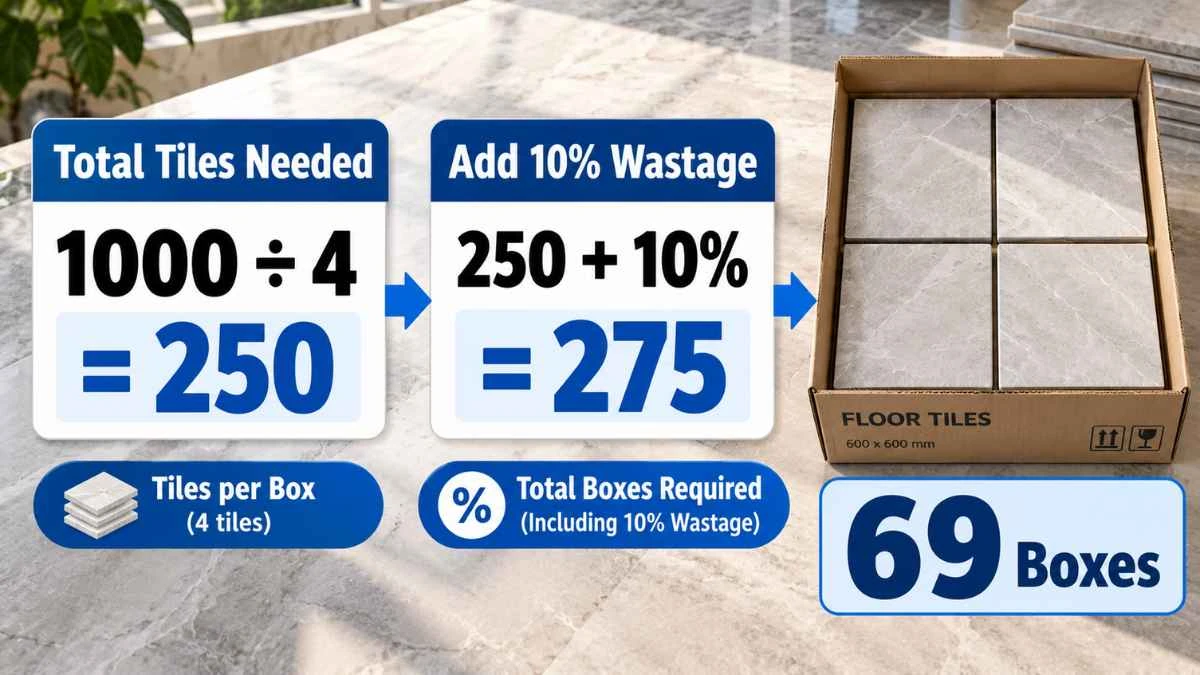
- Base quantity = 1000 ÷ 4 = 250 tiles
- 10% wastage = 250 × 0.10 = 25 tiles
- Total to order = 250 + 25 = 275 tiles
A standard box of 600 × 600 mm tiles holds 4 pieces and covers about 16 sq ft.
275 ÷ 4 = 68.75 → order 69 boxes.
Second Worked Example Bathroom + Corridor Scenario
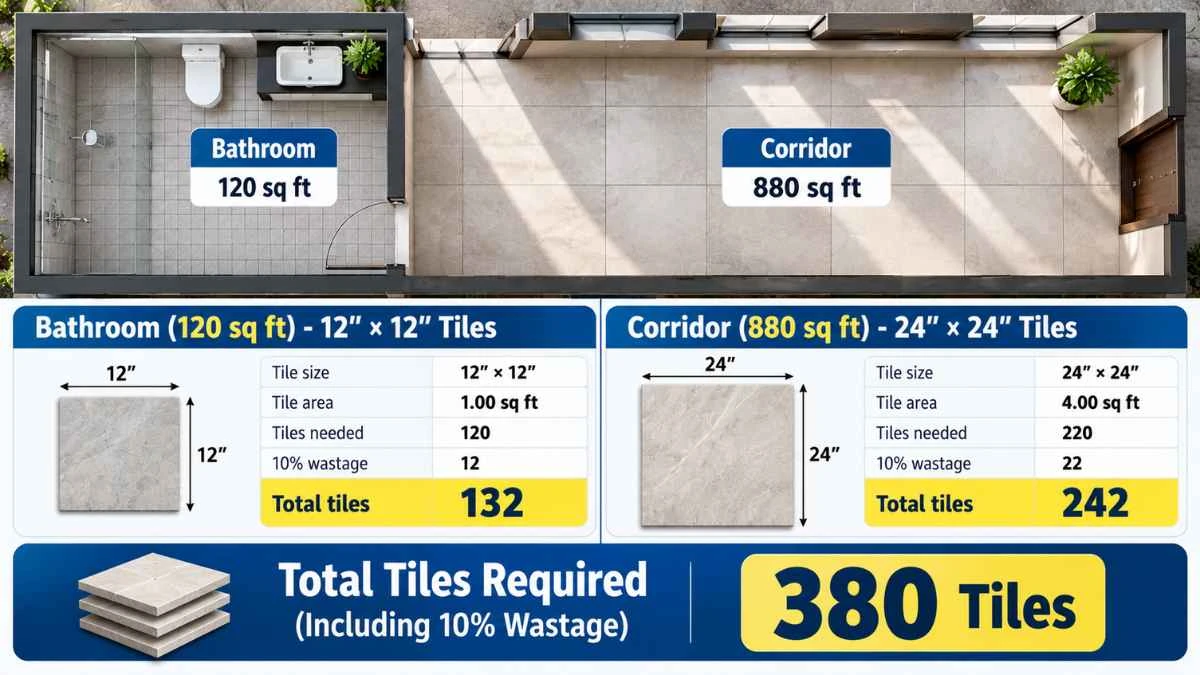
Suppose you have a 1000 sq ft total but part of it is a bathroom using smaller anti-skid tiles and the rest is corridor using 600 × 600 mm tiles.
- Bathroom floor: 120 sq ft with 12 × 12 inch tiles
Base = 120 ÷ 1 = 120 tiles
+15% wastage (more cuts around fixtures) = 138 tiles - Remaining 880 sq ft with 24 × 24 inch tiles
Base = 880 ÷ 4 = 220 tiles
+10% wastage = 242 tiles
Grand total = 138 + 242 = 380 tiles.
Always calculate each zone separately when tile sizes differ.
How Much Wastage Should You Really Add?
Industry practice and site experience show:
- Straight layout, simple rectangular rooms → 8–10%
- Rooms with many corners, pillars, or doorways → 12%
- Diagonal layout → 15%
- Herringbone or complex patterns → 15–20%
- Large-format tiles (800 mm and above) → start at 12–15% because each broken piece is expensive
Keep at least one full box of the same shade and batch for future repairs. Tile batches change colour slightly over time.
Practical Tips Before You Order
Measure twice. Use a laser measure or long tape. Add the lengths of all walls and divide by two if the room is irregular.
Check the box label for actual coverage. Some 600 × 600 mm tiles are slightly smaller after rectification.
Buy all boxes from the same production lot. Write the lot number on the delivery challan.
Ask the dealer for the number of tiles per box and total coverage per box. Do not assume.
For skirting, calculate running feet separately: perimeter of the room × height of skirting (usually 4 inch or 100 mm). Convert that extra area into tiles.
Common Mistakes That Cause Shortages
Forgetting wastage is the number one error. People calculate 250 tiles for 2 × 2 ft and order exactly 250. Then cutting losses leave them short.
Ignoring doors and open arches. Deduct only fixed cupboards or permanent platforms that will never get tiles.
Mixing different tile sizes without separate calculations.
Ordering before the floor is ready. Substrate level, expansion joints, and final dimensions can change the net area.
Cost Angle Quick Budget Check
At average 2026 rates in India, 600 × 600 mm vitrified tiles cost ₹45/80 per sq ft. For 1000 sq ft plus 10% wastage you need about 1100 sq ft of tile coverage. Material cost alone sits between ₹50,000 and ₹88,000 before labour, adhesive, and grout.
Labour usually runs ₹25/45 per sq ft depending on city and pattern. Keep a 5/7% contingency for unexpected cuts.
External Standards That Matter
Tile quality in India is governed by IS 15622:2017 (Pressed Ceramic Tiles Specification). It classifies tiles by water absorption and sets minimum strength and dimensional tolerance. For floor tiles choose Group BIa or BIb (water absorption ≤ 3%).
Laying practices follow guidelines in the National Building Code of India and manufacturer recommendations. Always store tiles flat, in a dry place, and check for shade variation before fixing starts.
Final Checklist Before You Buy
- Exact measured area confirmed
- Tile size and coverage per box noted
- 10% (or higher) wastage added
- Same lot and shade ordered
- Spare box kept aside
- Adhesive and grout quantities calculated separately
When you follow the formula and the table above, 1000 square feet becomes a straightforward calculation instead of a guessing game. Measure carefully, add the wastage, and order once.
Also Read
How to Calculate Construction Site Capacity Avoid 90% Errors
Frequently Asked Questions

Ar. Prince Badaik Is A Civil Engineering And Construction Content Creator At Civil Cost. He Shares Practical Information About Construction, Building Materials, Quantity Estimation, Costing, And Structural Engineering In A Simple And Easy To Understand Way.






Comments (0)