
Density of Cement 1440 kg/m³ Explained
The bulk density of cement is 1440 kg/m³. This guide explains bulk vs particle density (3150 kg/m³), specific gravity 3.15, bag volume, mix calculations, IS codes, worked examples, comparison tables, and common mistakes for beginners.
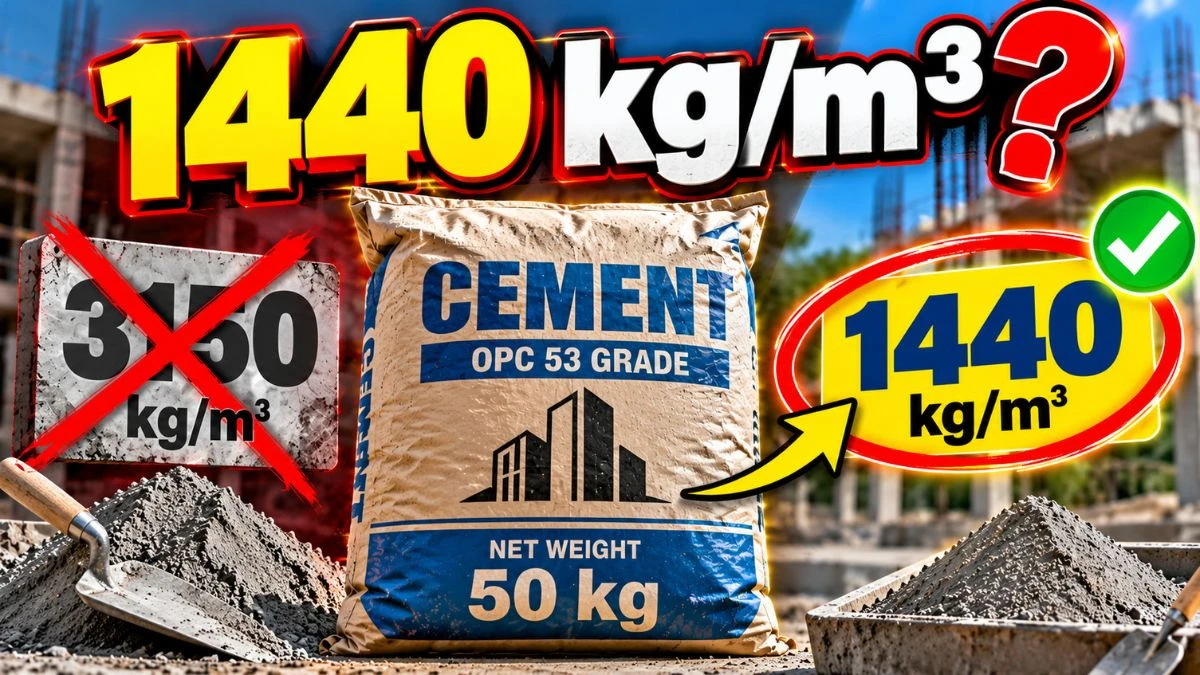
The bulk density of cement is 1440 kg/m³. This is the value used in almost every site calculation, bag-to-volume conversion, and concrete mix design in India.
Cement particle density (absolute density) is about 3150 kg/m³, and specific gravity is typically 3.15. These three numbers look similar but serve completely different purposes. Mixing them up is the most common beginner mistake.
What Is Density of Cement ?
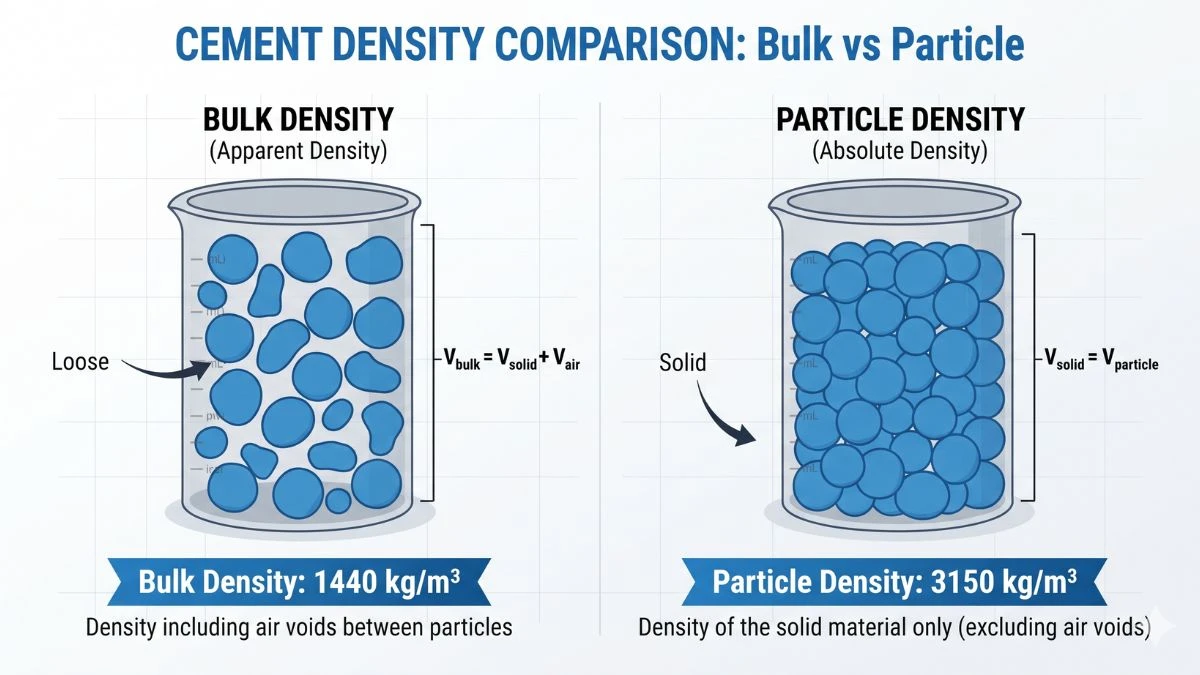
Density is mass divided by volume. For cement we talk about two different densities:
- Bulk density mass of cement including the air voids between particles. Standard value: 1440 kg/m³.
- Particle density (absolute density) mass of solid cement particles only, with no air voids. Standard value: approximately 3150 kg/m³.
Bulk density is the number you use on site. Particle density is the number used in absolute-volume mix design calculations.
Bulk Density vs Particle Density The Key Difference
| Property | Bulk Density | Particle Density |
|---|---|---|
| What it includes | Cement particles + air voids | Only solid cement particles |
| Standard value (OPC) | 1440 kg/m³ | 3150 kg/m³ |
| Changes with packing | Yes | No |
| Used for | Bag volume, site estimation | Mix design (absolute volume) |
| Specific gravity link | Not directly | Specific gravity ≈ 3.15 |
Particle density stays almost constant. Bulk density changes with how loosely or tightly the cement is packed. Freshly pneumatic-conveyed cement can be as low as 1100–1200 kg/m³. Settled cement in a bag is taken as 1440 kg/m³. Compacted or caked cement can go up to 1500–1600 kg/m³.
Specific Gravity of Cement
Specific gravity is the ratio of the density of cement particles to the density of water (1000 kg/m³).
For ordinary Portland cement the typical value is 3.15.
That means particle density = 3.15 × 1000 = 3150 kg/m³.
IS 4031 (Part 11):1988 gives the standard laboratory method using a Le Chatelier flask and kerosene (because water reacts with cement).
Typical ranges:
- OPC: 3.10 – 3.16
- PPC: 2.90 – 3.05
- PSC: 2.85 – 2.95
Density of Different Types of Cement
| Cement Type | Particle Density (kg/m³) | Bulk Density (kg/m³) |
|---|---|---|
| Ordinary Portland Cement (OPC) | 3150 | 1440 |
| Rapid Hardening Cement | 3150 | 1280–1440 |
| Portland Pozzolana Cement (PPC) | 2900–3050 | 1200–1350 |
| Portland Slag Cement (PSC) | 2850–2950 | 1250–1400 |
| Sulphate Resisting Cement | 3150 | 1480 |
| White Portland Cement | 3000–3080 | 1460 |
| Low Heat Cement | 3100–3150 | 1440–1500 |
| High Alumina Cement | 3000–3250 | 1100–1200 |
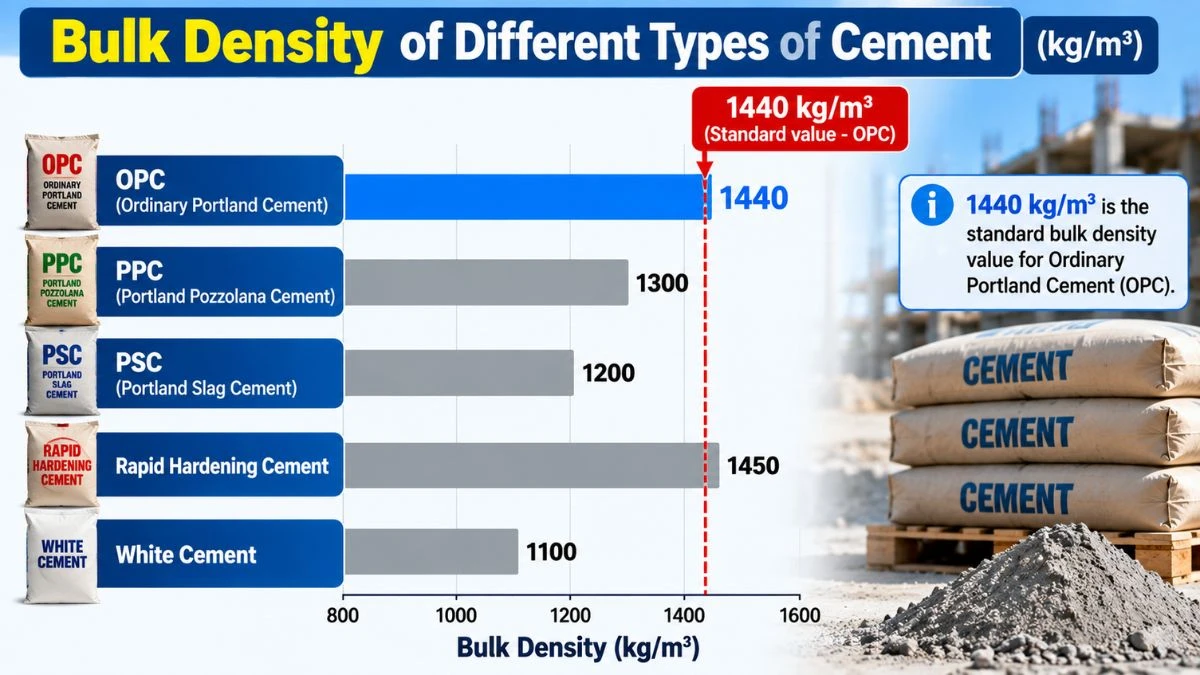
Bulk density values used in day-to-day work remain close to 1440 kg/m³ for OPC. Blended cements are slightly lighter because of the lower density of fly ash or slag.
Why Density of Cement Matters on Site
- Converting bag weight to volume
- Calculating number of bags for a given concrete volume
- Absolute-volume method of mix design
- Checking whether cement has absorbed moisture (specific gravity rises)
- Estimating storage space in silos or godowns
Volume of One 50 kg Bag of Cement
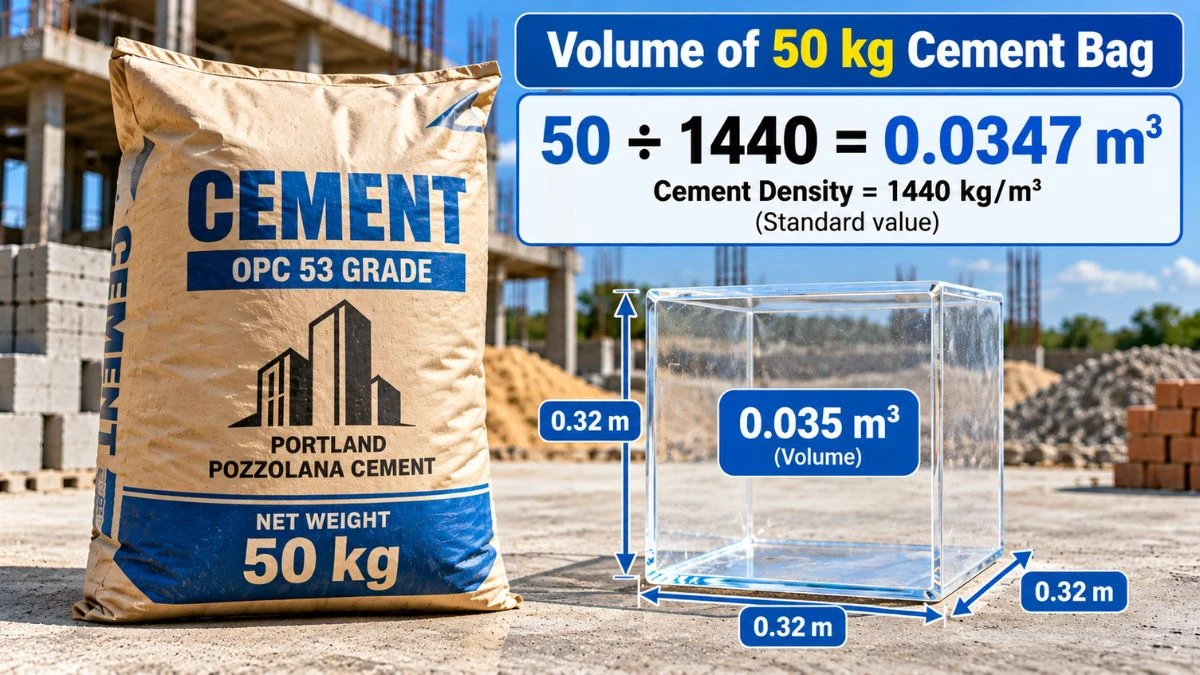
Using the standard bulk density of 1440 kg/m³:
Volume of one bag = Mass ÷ Bulk density
= 50 ÷ 1440
= 0.03472 m³
≈ 0.035 m³ or 34.72 litres
≈ 1.23 cubic feet
Number of bags in 1 m³ of cement (by volume) = 1440 ÷ 50 = 28.8 bags.
This single calculation is used every day while ordering cement and preparing site estimates.
Worked Example 1 Floor Slab
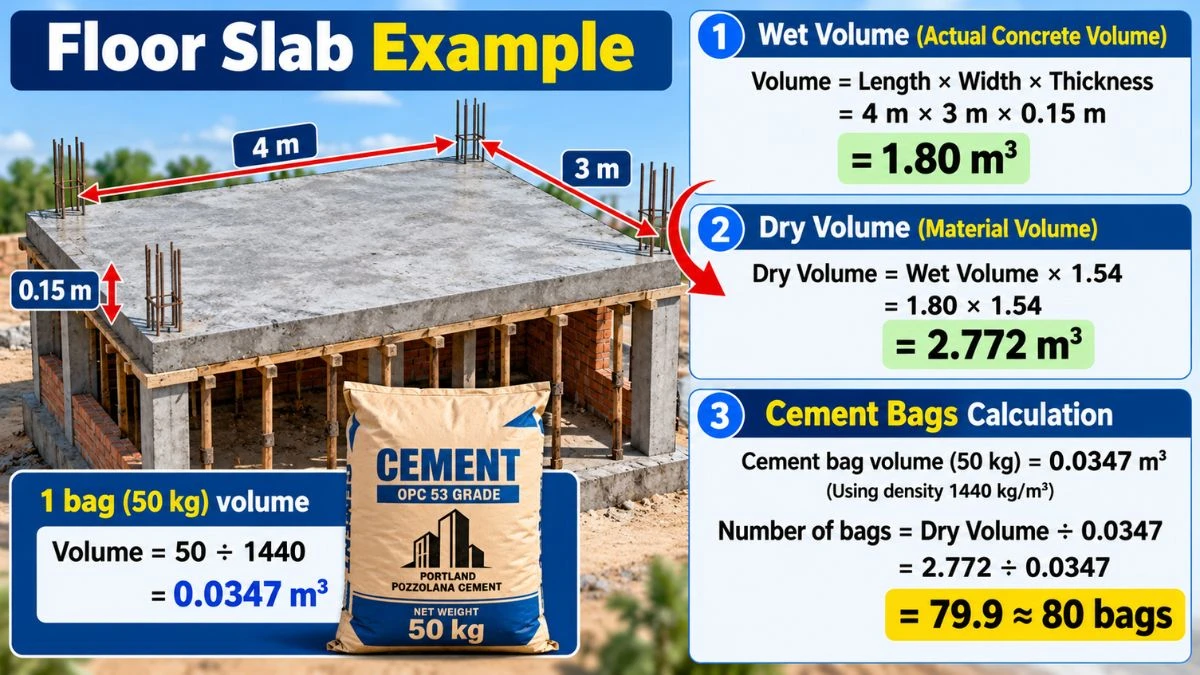
You need to cast a 4 m × 3 m × 0.15 m slab in M20 concrete (1:1.5:3 by volume).
Wet volume of concrete = 4 × 3 × 0.15 = 1.8 m³
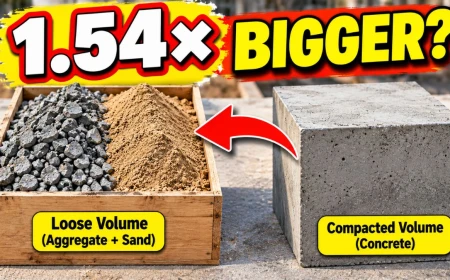
Dry volume (add 54 %) = 1.8 × 1.54 = 2.772 m³
Cement part = 1 / (1+1.5+3) = 1/5.5
Cement volume = 2.772 × (1/5.5) = 0.504 m³
Cement bags = 0.504 × 28.8 ≈ 14.5 bags
(Use 15 bags including wastage).
Worked Example 2 Column
A 300 mm × 450 mm column, 3.2 m high.
Volume of one column = 0.3 × 0.45 × 3.2 = 0.432 m³
Dry volume = 0.432 × 1.54 = 0.665 m³
Using M25 (1:1:2)
Cement part = 1 / 4
Cement volume = 0.665 × 0.25 = 0.166 m³
Bags required = 0.166 × 28.8 ≈ 4.8 bags
(Take 5 bags per column).
Same density figure (1440 kg/m³) is applied in both slab and column calculations.
Factors That Affect Bulk Density
- Degree of compaction or vibration
- Moisture content (damp cement packs differently)
- Fineness of grinding
- Age and storage condition (caking increases density)
- Method of filling (pneumatic vs manual)
For estimation purposes, Indian practice always uses the conventional value of 1440 kg/m³ unless a project specification states otherwise.
How Density Is Measured in the Laboratory
IS 4031 (Part 11):1988 describes the procedure:
- Fill a Le Chatelier flask with kerosene to a known mark.
- Weigh approximately 64 g of cement.
- Add cement carefully into the flask.
- Remove air bubbles by rolling the flask.
- Record the new liquid level.
- Density = mass of cement (g) ÷ displaced volume (cm³).
The result is the particle density. Specific gravity is obtained by dividing by the density of water.
Common Mistakes Beginners Make
- Using 3150 kg/m³ instead of 1440 kg/m³ for bag volume → volume comes out three times smaller and cement quantity is wrong.
- Assuming bulk density is the same for all cement types.
- Ignoring that bulk density changes with packing while particle density does not.
- Forgetting the 1.54 dry-volume factor when converting wet concrete volume.
- Taking specific gravity as bulk density.
Density Values as per IS Codes
- IS 875 (Part 1) lists ordinary cement unit weight as 14.4 kN/m³ (approximately 1440 kg/m³).
- IS 4031 (Part 11) 1988 gives the official method for determining density of hydraulic cement.
- These values are the basis for most estimation and design practice in India.
Practical Tips for Site Use
Always keep one consistent bulk density (1440 kg/m³) throughout a project. Change it only if the laboratory report or project specification gives a different measured value. Store cement in dry conditions so that bulk density and specific gravity stay within normal range. Check bag weight occasionally; a 50 kg bag should not vary significantly.
Understanding the difference between 1440 kg/m³ and 3150 kg/m³ removes the biggest source of confusion for beginners and keeps material calculations accurate.
Also Read
How to Calculate Construction Site Capacity Avoid 90% ErrorsFrequently Asked Questions

Ar. Prince Badaik Is A Civil Engineering And Construction Content Creator At Civil Cost. He Shares Practical Information About Construction, Building Materials, Quantity Estimation, Costing, And Structural Engineering In A Simple And Easy To Understand Way.









Comments (0)