
Round Water Tank Capacity Calculation Formula
Learn the exact round water tank capacity calculation formula used by engineers and homeowners. This beginner-friendly guide shows the simple π × r² × h formula, step-by-step worked examples in litres, unit conversions, common mistakes that give 4× wrong answers, standard size tables, and practical tips so you can size any cylindrical tank correctly the first time.
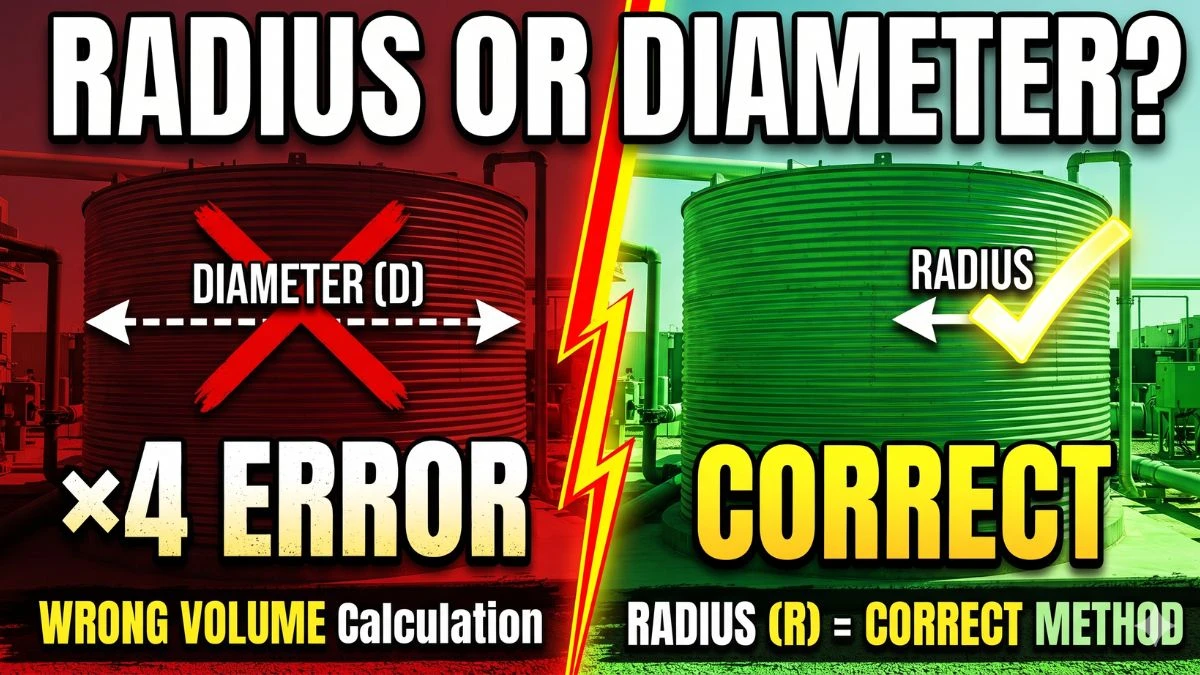
The round water tank capacity calculation formula is V = π × r² × h. Here V is the volume, π is approximately 3.14, r is the internal radius (half the diameter), and h is the internal height of the water column. Multiply the result in cubic metres by 1,000 to get capacity in litres.
Most people measuring a round (cylindrical) water tank make one simple mistake: they put the full diameter into the formula instead of the radius. That single error multiplies the answer by four and leads to tanks that are either far too small or dangerously oversized for the foundation.
This guide walks you through the exact formula, shows two complete real-world examples, gives a ready-to-use size table, explains unit conversions, and lists the common errors that cost money on site.
Why Correct Capacity Calculation Matters
Knowing the true capacity of a round water tank helps you:
- Match daily household or farm water demand
- Choose the right pump and pipe sizes
- Avoid overloading the roof or staging structure
- Compare manufacturer claims with actual internal volume
- Plan freeboard (extra height above the water line) correctly
In India, plastic tanks follow IS 12701 and RCC tanks follow IS 3370. Both standards define capacity as the usable volume between the outlet level and the full-supply level. The geometric formula below gives the gross volume; you then subtract freeboard and dead storage if needed.
The Exact Round Water Tank Capacity Formula
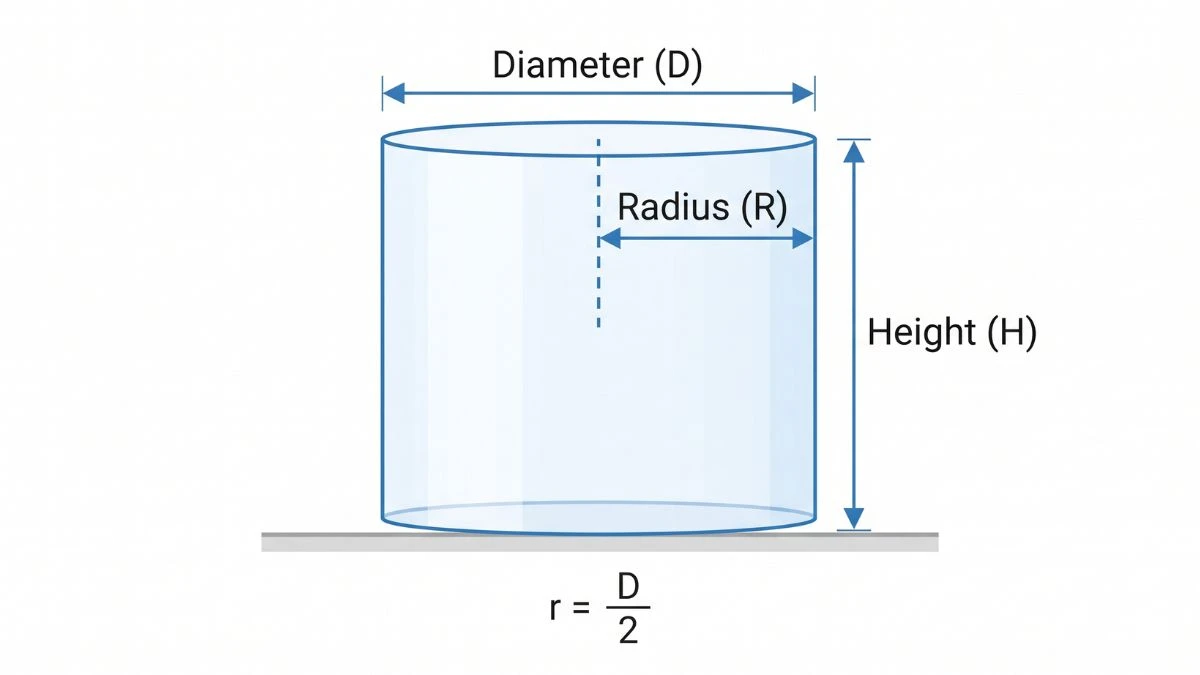
For a vertical cylindrical (round) tank the formula is:
Volume (m³) = π × r² × h
Capacity in litres = π × r² × h × 1,000
Where:
- π (pi) ≈ 3.14 (or 3.1416 for more precision)
- r = internal radius in metres = diameter ÷ 2
- h = internal height of the water column in metres
You can also write it using diameter:
Volume (m³) = π × (D/2)² × h = (π × D² × h) / 4
Always measure the internal diameter and height. Wall thickness on plastic tanks can be 5–15 mm; on RCC tanks it is usually 150–250 mm. Using external measurements overstates capacity.
Quick Conversion Factors
| Unit | Conversion |
|---|---|
| 1 m³ | 1,000 litres |
| 1 m³ | 35.315 cubic feet |
| 1 cubic foot | 28.317 litres |
| 1 US gallon | 3.785 litres |
| 1 UK gallon | 4.546 litres |
Step By Step Method to Calculate Capacity
- Measure the internal diameter of the tank at the widest point.
- Divide the diameter by 2 to get the radius (r).
- Measure the internal height from the floor to the maximum water level (h).
- Square the radius (r × r).
- Multiply by π (3.14).
- Multiply by height (h).
- Multiply by 1,000 to convert cubic metres into litres.
That is the complete calculation.
Worked Example 1 Common 1,000 Litre Home Tank
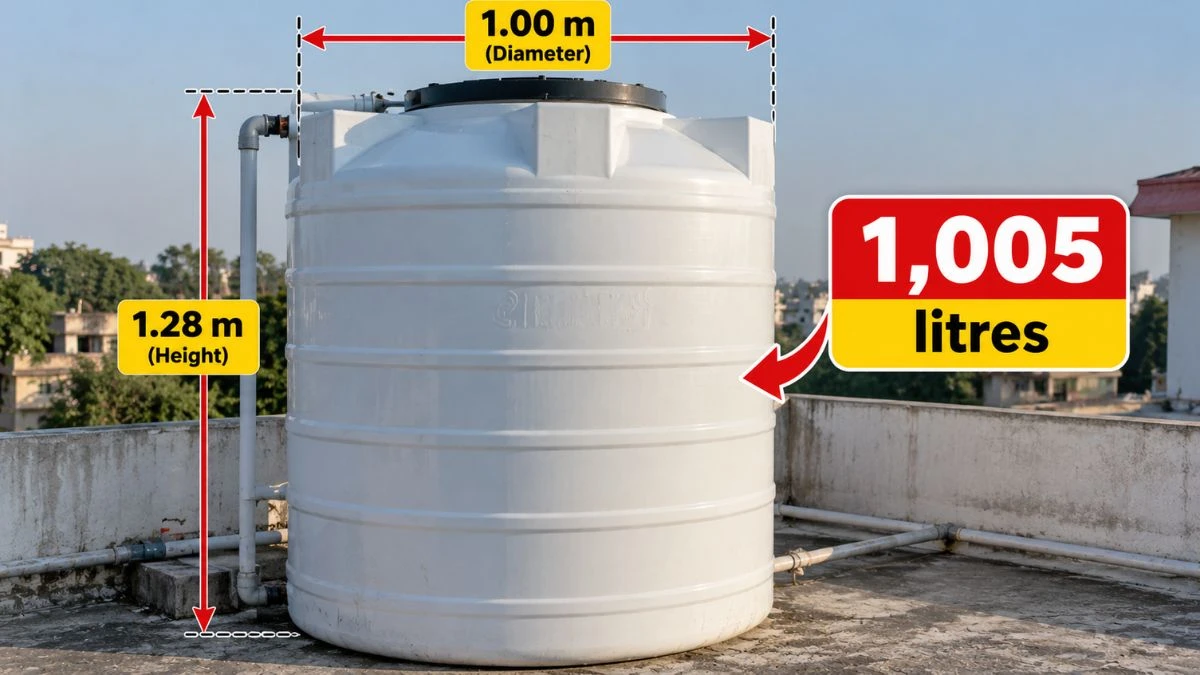
A typical plastic overhead tank has:
- Internal diameter = 1.00 m
- Internal height = 1.28 m
Step 1: Radius r = 1.00 ÷ 2 = 0.50 m
Step 2: r² = 0.50 × 0.50 = 0.25
Step 3: π × r² = 3.14 × 0.25 = 0.785
Step 4: Volume = 0.785 × 1.28 = 1.0048 m³
Step 5: Capacity = 1.0048 × 1,000 = 1,005 litres
This matches the standard 1,000-litre tank size sold across India.
Worked Example 2 Larger Farm / Community Tank
A farmer needs a larger ground-level round tank:
- Internal diameter = 2.40 m
- Internal height = 2.00 m
Step 1: Radius r = 2.40 ÷ 2 = 1.20 m
Step 2: r² = 1.20 × 1.20 = 1.44
Step 3: π × r² = 3.14 × 1.44 = 4.5216
Step 4: Volume = 4.5216 × 2.00 = 9.0432 m³
Step 5: Capacity = 9.0432 × 1,000 = 9,043 litres (approximately 9,000 litres)
You can now decide whether this size meets the daily requirement or if a second tank is needed.
Common Round Tank Sizes and Capacities
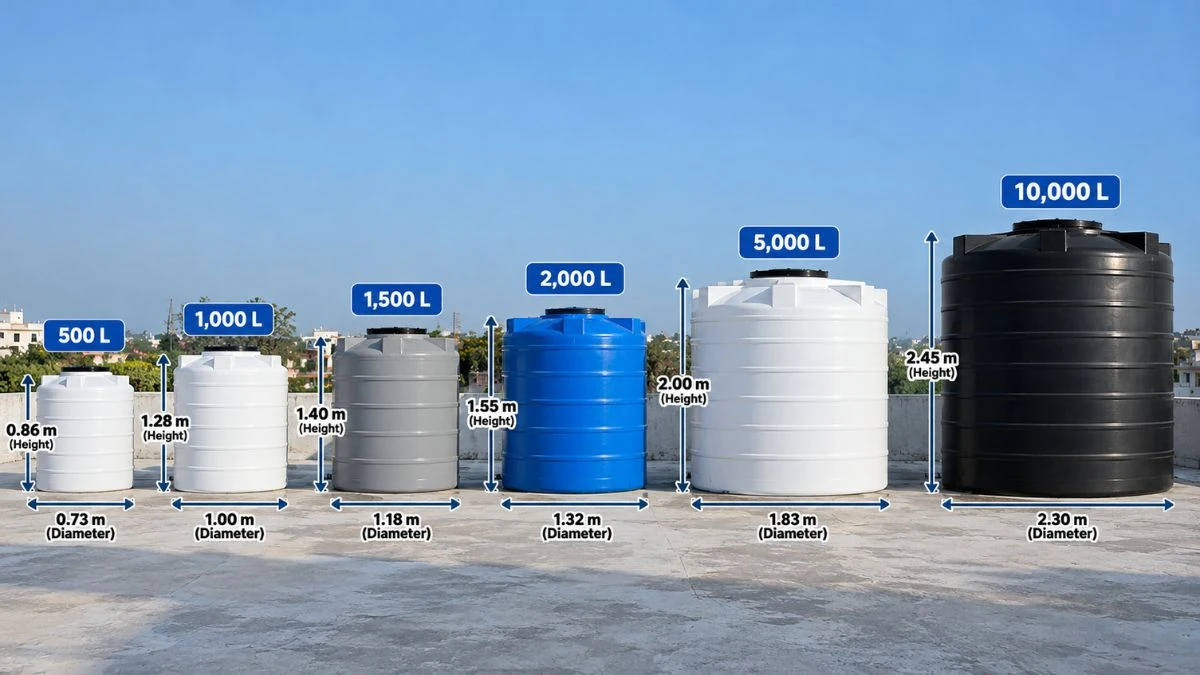
| Nominal Capacity | Approximate Internal Diameter | Approximate Internal Height | Calculated Capacity |
|---|---|---|---|
| 500 L | 0.80 m | 1.00 m | 503 L |
| 1,000 L | 1.00 m | 1.28 m | 1,005 L |
| 1,500 L | 1.20 m | 1.33 m | 1,504 L |
| 2,000 L | 1.30 m | 1.51 m | 2,004 L |
| 5,000 L | 1.80 m | 1.97 m | 5,013 L |
| 10,000 L | 2.30 m | 2.41 m | 10,013 L |
These dimensions are typical for rotational-moulded polyethylene tanks (IS 12701). Always verify actual internal measurements on the tank you buy, because manufacturers sometimes round the labelled capacity upward.
Horizontal Round Tanks Different Formula
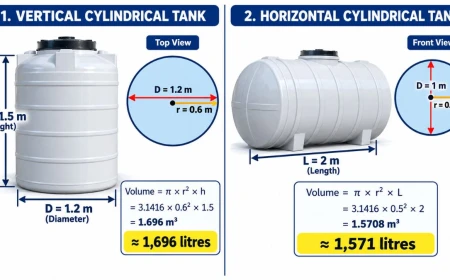
If the tank lies on its side (common for some underground or mobile tanks), total capacity is still π × r² × L, where L is the length. Partial-fill calculations become more complex because the water surface forms a circular segment. For most domestic and farm overhead tanks the vertical formula above is the one you need.
Most Common Mistakes and How to Avoid Them
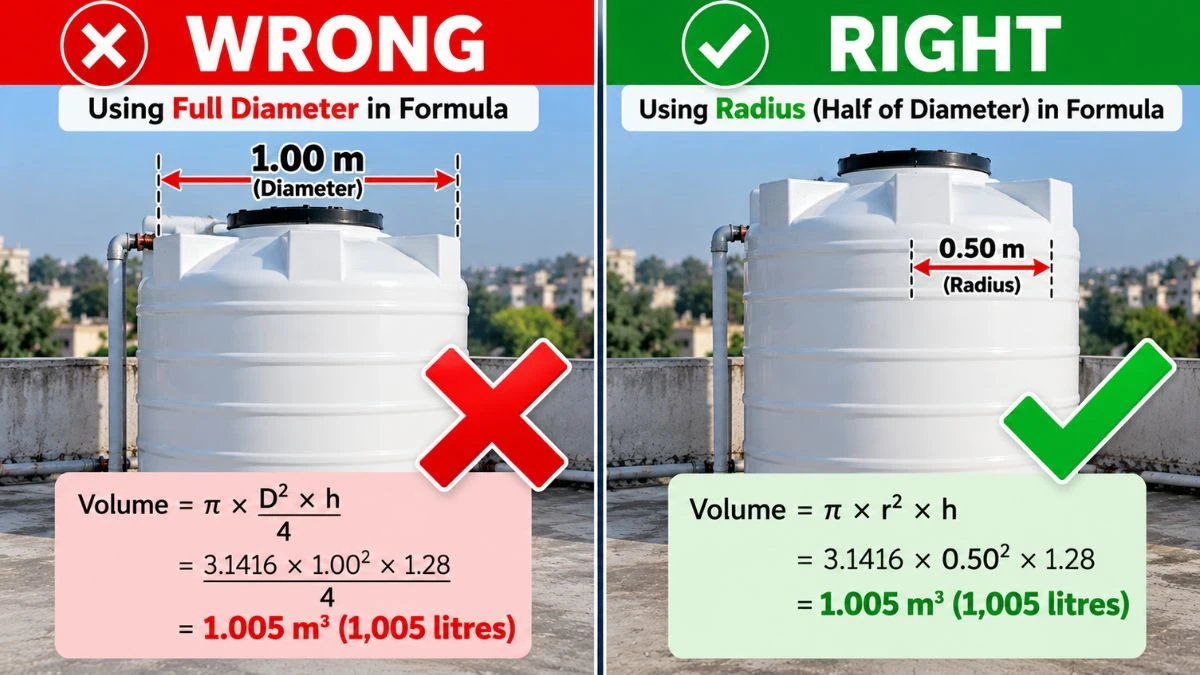
- Using diameter instead of radius
This multiplies the answer by four. Always divide diameter by two first. - Measuring external dimensions
Wall thickness reduces usable volume. Measure inside or subtract twice the wall thickness from external diameter. - Forgetting freeboard
Leave 150–300 mm empty at the top for expansion, wave action, and overflow pipe. IS 3370 recommends this freeboard for RCC tanks. - Mixing units
Keep everything in metres (or everything in centimetres and divide by 1,000,000 for litres). Mixing metres and centimetres produces huge errors. - Ignoring the dome or conical bottom
Some tanks have a raised floor or domed roof. Subtract that volume or measure only the cylindrical portion that actually holds water.
Practical Tips for Accurate Measurement
- Use a steel tape, not a cloth tape that stretches.
- Measure diameter in two directions (north-south and east-west) and average them if the tank is slightly out of round.
- For plastic tanks, measure at mid-height because some tanks taper slightly.
- Write the numbers down before calculating. Mental arithmetic often drops a zero.
- Double-check by calculating volume two ways: using radius and using diameter formula. Both must give the same answer.
When to Use a Tank Capacity Calculator
Online tank capacity calculators are useful for quick checks, but they only work if you enter the correct radius and height. Understanding the formula yourself lets you verify the calculator result and catch input mistakes. The formula is also essential when the calculator is offline or when you need to reverse-calculate the required diameter for a given capacity and height limit.
Capacity vs Daily Water Demand
Once you know the tank capacity, compare it with daily use. A typical Indian household of four uses 400/600 litres per day for all purposes. A 1,000-litre tank therefore gives roughly 1.5/2.5 days of storage if supply is intermittent. Farms and institutions need larger multiples based on livestock, irrigation, or number of users (refer to IS 1172 for recommended per-capita figures).
Summary of the Formula
Remember the core line:
Capacity (litres) = 3.14 × (diameter ÷ 2)² × height × 1,000
Measure internal diameter and height in metres, square the radius, multiply by π and by height, then multiply by 1,000. That single calculation gives you the accurate round water tank capacity every time.
ALSO READ : 1000 Square Feet Requires How Many Tiles
Frequently Asked Questions

Ar. Prince Badaik Is A Civil Engineering And Construction Content Creator At Civil Cost. He Shares Practical Information About Construction, Building Materials, Quantity Estimation, Costing, And Structural Engineering In A Simple And Easy To Understand Way.











Comments (0)