
Wet Volume of Concrete Exact Formula and Calculation
Wet volume of concrete is the actual volume of mixed concrete that fills the formwork after water is added. Learn the simple formula, why the 1.54 factor is used to get dry volume, step by step calculations for slabs and columns, common mistakes, and how to avoid material shortages on site.
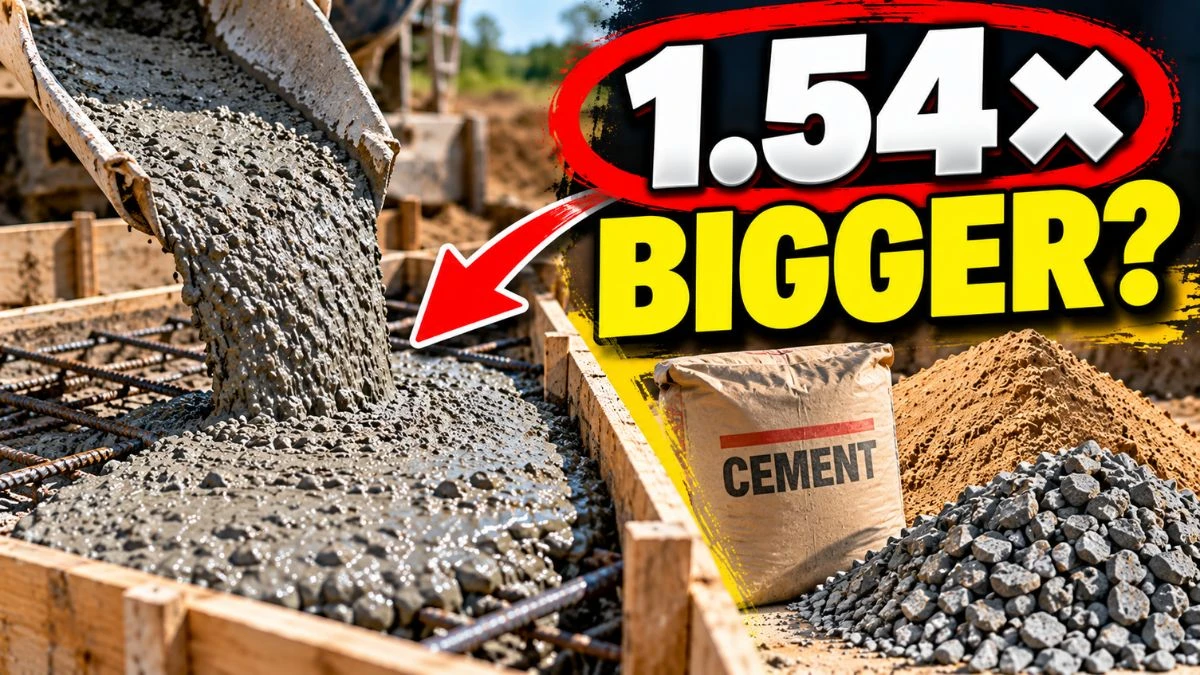
Wet volume of concrete is the actual volume of concrete after mixing cement, sand, aggregate and water. It equals the space inside the formwork that the fresh concrete fills.
You measure length × width × thickness of the member. That number is the wet volume.
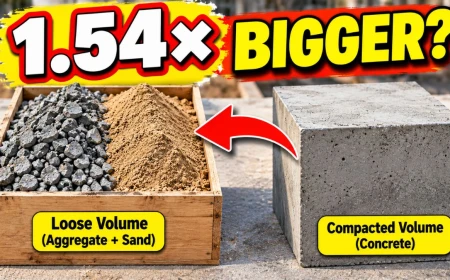
Most beginners stop there and order materials based only on wet volume. That is the most common mistake. Dry materials need extra volume because of voids. The standard conversion is dry volume = wet volume × 1.54.
This guide explains the definition, the formula, why 1.54 is used, two complete worked examples (slab and column), a comparison table, common site mistakes, and practical tips so you never run short of material.
What Is Wet Volume of Concrete ?
Wet volume is the volume of concrete in its plastic, workable state after water has been added.
When cement, sand and coarse aggregate are mixed dry, air voids exist between the particles. Adding water fills those voids and the particles pack tighter. The total volume shrinks. The final compacted volume that sits inside the shuttering is the wet volume.
In simple terms:
Wet volume = the volume of concrete you actually place in the structure.
It is also called the “finished” or “placed” volume.
Why Wet Volume Matters on Site
Every concrete member slab, beam, column or footing is designed to a specific size. That size is the wet volume you must fill.
If you calculate material quantities from wet volume alone, you will buy too little cement, sand and aggregate. The mix will not fill the formwork.
Ready-mix suppliers deliver wet volume. On site manual batching needs dry volume. Knowing the difference prevents both shortages and waste.
Wet Volume Formula
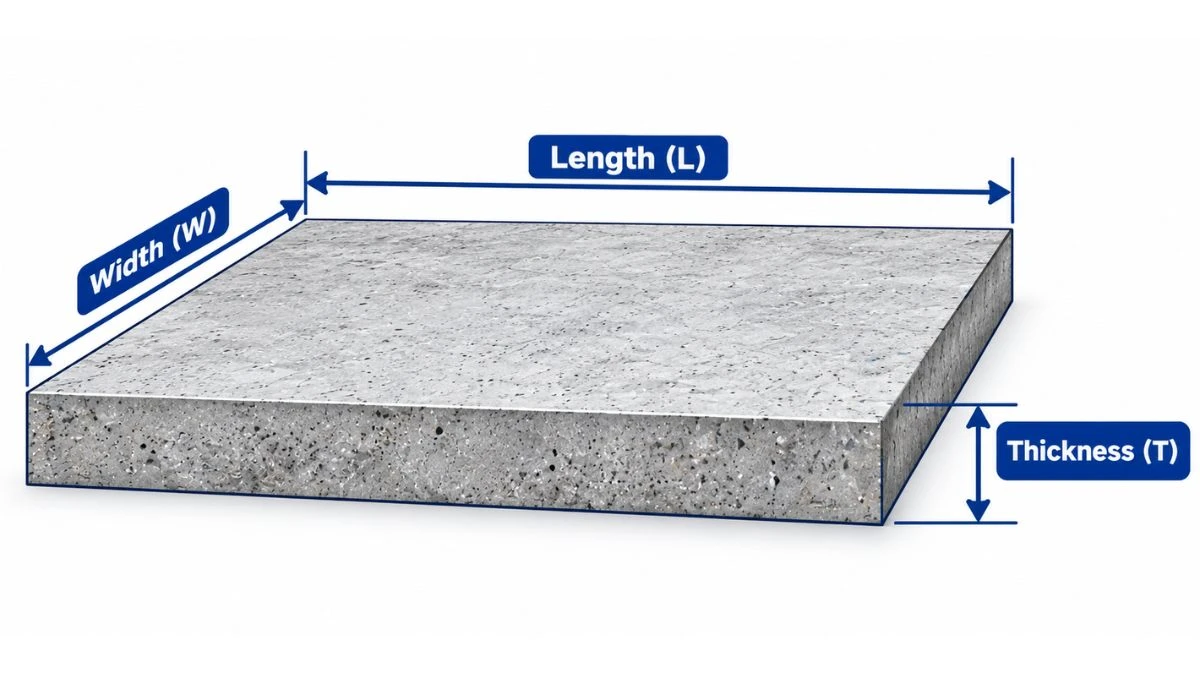
The basic formula is the same for almost every rectangular member:
Wet Volume = Length × Width × Thickness (or Depth)
All dimensions must be in the same unit (usually metres). The answer comes in cubic metres (m³).
Alternative form
Wet Volume = Area × Thickness
For circular columns:
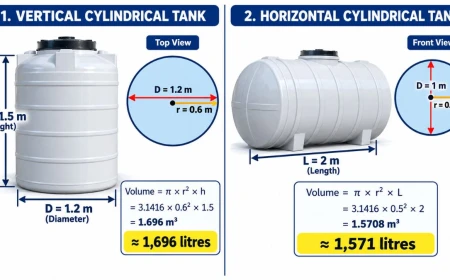
Wet Volume = π × r² × Height
Where π = 3.14 and r is the radius.
Why We Multiply by 1.54 to Get Dry Volume
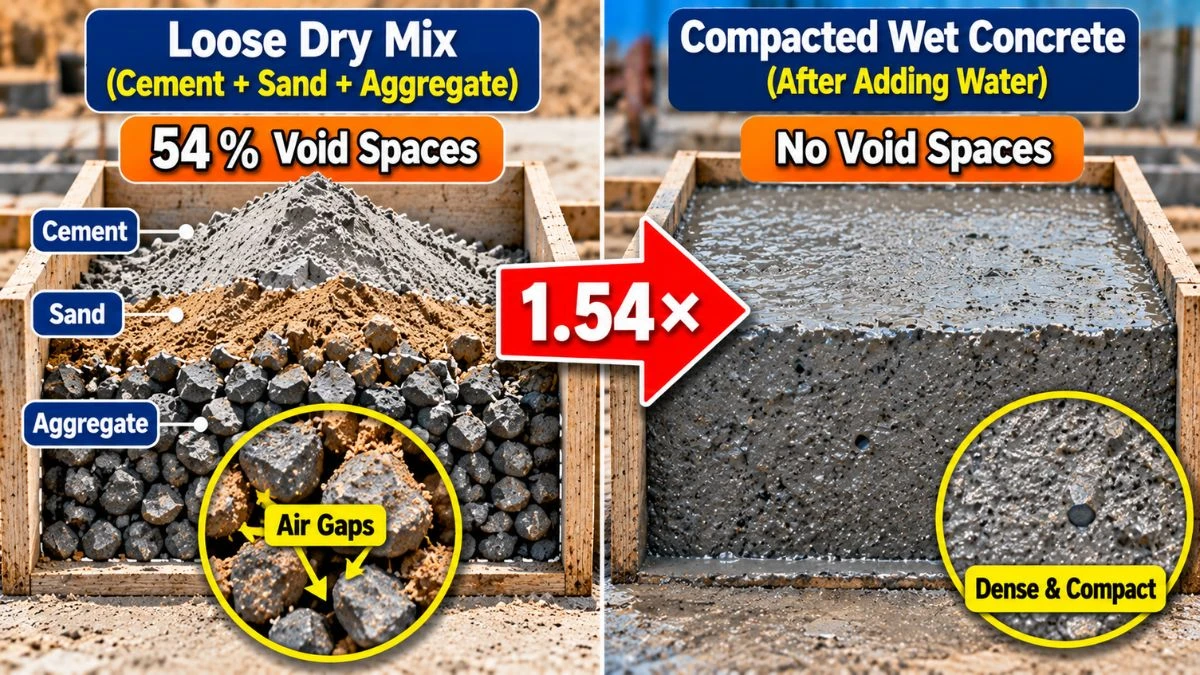
Dry materials contain voids.
Typical void percentages:
- Coarse aggregate: 32–34 %
- Sand: 20–27 %
- Cement: almost negligible
When these materials sit separately the total voids can reach about 54–61 %. Once mixed together and water is added, most voids disappear and the volume drops by roughly 54 %.
Therefore:
Dry Volume = Wet Volume × 1.54
This factor is standard practice in India for nominal mix calculations and is widely used with reference to IS 456 guidelines for estimating material quantities.
Some engineers use 1.52 or 1.55. The difference is less than 2 % and stays within normal site tolerance. Most quantity surveyors and site engineers stick to 1.54.
Step by Step Calculation Process
- Measure the structural member dimensions accurately.
- Calculate wet volume using the formula above.
- Add wastage (usually 5–10 % for slabs, 7–10 % for columns and beams).
- Multiply the adjusted wet volume by 1.54 to get dry volume.
- Split the dry volume according to the mix ratio (cement : sand : aggregate).
- Convert cement volume to bags using density 1440 kg/m³ (1 bag = 50 kg ≈ 0.035 m³).
Worked Example 1: Concrete Slab
Slab size: Length = 6 m, Width = 4 m, Thickness = 0.15 m
Mix: M20 (1 : 1.5 : 3)
Wastage: 5 %
Step 1 – Wet Volume
Wet Volume = 6 × 4 × 0.15 = 3.6 m³
Step 2 – Add Wastage
Adjusted Wet Volume = 3.6 × 1.05 = 3.78 m³
Step 3 – Dry Volume
Dry Volume = 3.78 × 1.54 = 5.8212 m³
Step 4 – Material Quantities
Total parts = 1 + 1.5 + 3 = 5.5
Cement volume = (1 / 5.5) × 5.8212 = 1.0584 m³
Cement weight = 1.0584 × 1440 = 1524 kg
Cement bags = 1524 / 50 ≈ 30.5 → order 31 bags
Sand volume = (1.5 / 5.5) × 5.8212 = 1.5876 m³
Aggregate volume = (3 / 5.5) × 5.8212 = 3.1752 m³
Worked Example 2 Rectangular Column
Column size: Length = 0.3 m, Width = 0.3 m, Height = 3.0 m
Mix: M20 (1 : 1.5 : 3)
Wastage: 8 %
Step 1 – Wet Volume
Wet Volume = 0.3 × 0.3 × 3.0 = 0.27 m³
Step 2 – Add Wastage
Adjusted Wet Volume = 0.27 × 1.08 = 0.2916 m³
Step 3 – Dry Volume
Dry Volume = 0.2916 × 1.54 = 0.4491 m³
Step 4 – Material Quantities
Total parts = 5.5
Cement volume = (1 / 5.5) × 0.4491 = 0.08165 m³
Cement weight = 0.08165 × 1440 ≈ 117.6 kg
Cement bags = 117.6 / 50 ≈ 2.35 → order 3 bags
Sand volume = (1.5 / 5.5) × 0.4491 = 0.1225 m³
Aggregate volume = (3 / 5.5) × 0.4491 = 0.2449 m³
These two examples show the same formula applied to a large horizontal member and a slender vertical member.
Comparison Table Wet Volume vs Dry Volume
| Parameter | Wet Volume | Dry Volume |
|---|---|---|
| Definition | Volume after water is added | Volume of loose dry materials |
| When measured | After mixing and placing | Before adding water |
| Formula | L × W × H | Wet Volume × 1.54 |
| Voids | Almost zero after compaction | 52–54 % air voids present |
| Used for | Ordering ready-mix concrete | Buying cement, sand, aggregate |
| Typical value for 1 m³ | 1 m³ | 1.54 m³ |
| Relation to structure size | Equal to formwork volume | 54 % larger than formwork volume |
Common Mistakes Beginners Make
- Ordering materials using only wet volume results in shortage.
- Forgetting wastage 5–10 % is normal on site.
- Using wrong units mixing metres and millimetres.
- Ignoring bulking of wet sand wet sand occupies more volume.
- Applying 1.54 to ready mix orders ready-mix is already wet volume.
Practical Tips for Accurate Estimation
- Always measure formwork after it is fixed and levelled.
- For complex shapes (stairs, curved walls) break them into simple rectangles or use average thickness.
- Keep a small extra stock of cement bags for last-minute adjustments.
- Record actual consumption after every pour and compare with calculated quantities. This improves future estimates.
- Follow IS 456:2000 guidelines for nominal mixes and workmanship. CPWD specifications also recommend similar volume adjustments for estimation.
Difference Between Wet Volume and Dry Volume in One Line
Wet volume is what you place; dry volume is what you buy.
Conclusion
Wet volume of concrete is simply the formwork volume calculated as length × width × thickness. To convert it into the quantity of dry materials you need, multiply by 1.54. Add a realistic wastage factor, then split the dry volume according to your mix ratio.
Use the two worked examples above as templates. Check dimensions carefully, apply the 1.54 factor every time you batch on site, and you will avoid the most common material shortage that beginners face.
Accurate wet volume calculation is the first and most important step toward reliable concrete estimation.
Frequently Asked Questions

Ar. Prince Badaik Is A Civil Engineering And Construction Content Creator At Civil Cost. He Shares Practical Information About Construction, Building Materials, Quantity Estimation, Costing, And Structural Engineering In A Simple And Easy To Understand Way.








Comments (0)