
Tank Calculation Formula in Litres (m³ × 1000 = Litres)
A simple guide to the tank calculation formula for rectangular, cylindrical, horizontal, cone-bottom and L-shaped tanks. It explains the 1000 conversion that turns cubic metres into litres. It includes worked examples in metres, centimetres and feet, ready-made size charts, and a method to size a water tank for your family using Indian code figures.
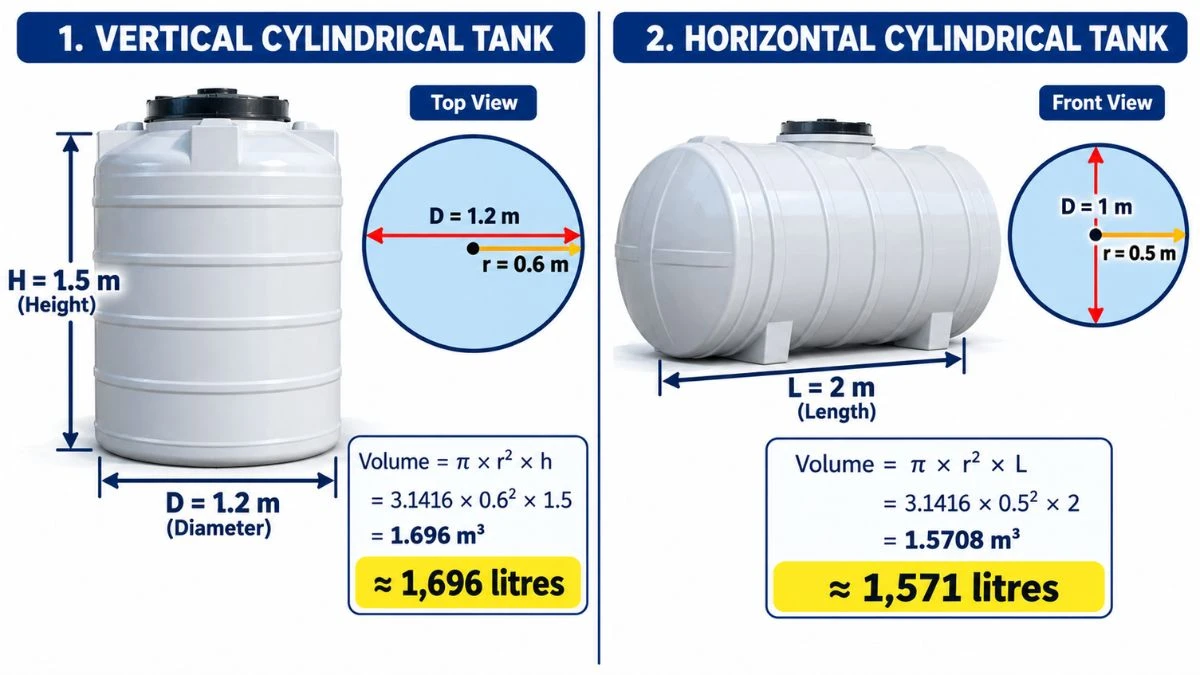
Tank volume is length × width × height for a rectangular tank, and π × radius² × height for a round one. Measure in metres, then multiply the answer by 1000 to get litres.
That last step trips up a lot of beginners. Some people forget the 1000 completely. Others multiply when they should divide. If you’ve ever worked out a sump the size of a small room and got “7.5 litres,” you know how that goes.
This guide covers the tank calculation formula for every common shape. You’ll get worked examples in metres, centimetres and feet, plus size charts that work like a water tank volume calculator in litres. You’ll also see how to size a tank for your family using the water demand figures in Indian codes.
Tank Calculation Formula at a Glance
Here’s the quick version. Keep this table handy and read the sections below for the steps.
| Tank shape | Volume formula | Litres (dimensions in metres) |
|---|---|---|
| Rectangular or square | L × W × H | L × W × H × 1000 |
| Vertical cylinder | π × r² × H | π × r² × H × 1000, or D² × H × 785.4 |
| Horizontal cylinder (full) | π × r² × Length | π × r² × Length × 1000 |
| Cone-bottom tank | Cylinder part + (⅓ × π × r² × h) | Total × 1000 |
| L-shaped or irregular | Split into rectangles, then add | Total × 1000 |
Two rules apply to every row. First, use internal dimensions, because only the space inside the walls holds water. Second, keep all measurements in the same unit before you multiply.
How to Convert Tank Volume to Litres (The 1000 Rule)
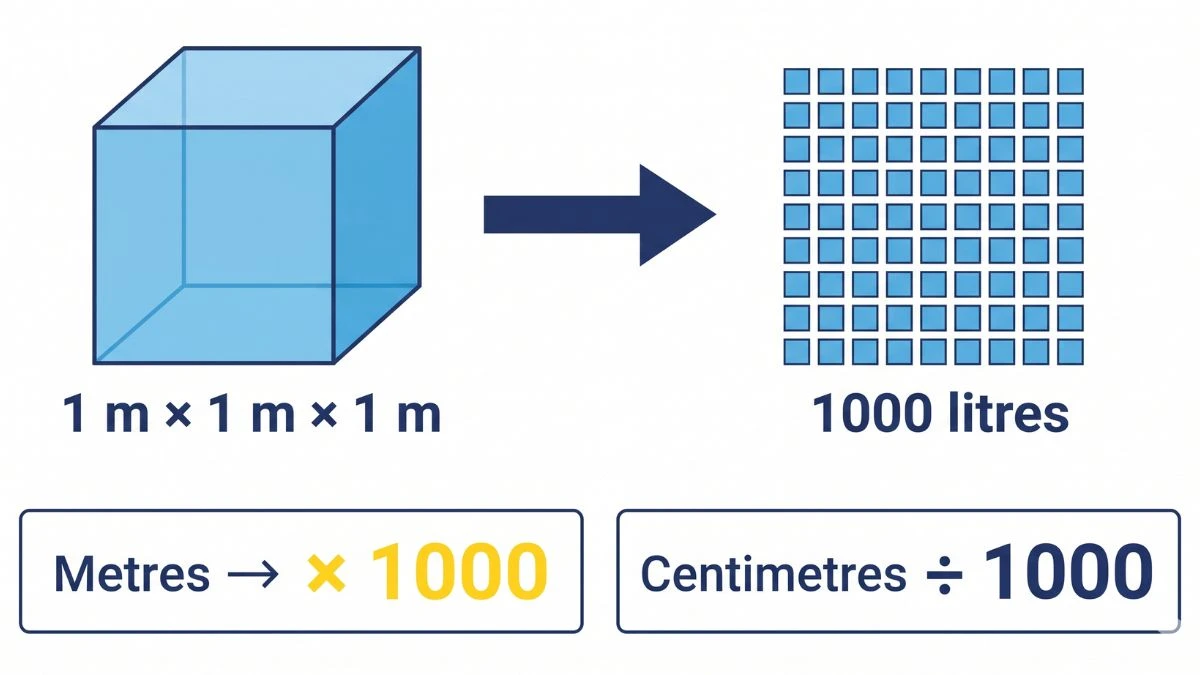
Every tank formula gives you a volume in cubic units. Litres come from one simple fact: 1 m³ equals 1000 litres.
Here’s why. One metre is 100 cm, so a cube of 1 m × 1 m × 1 m holds 100 × 100 × 100 = 1,000,000 cm³. One litre is 1000 cm³. Divide 1,000,000 by 1000 and you get 1000 litres.
Use this table to pick the right move for your unit.
| You measured in | Cubic unit | Convert to litres |
|---|---|---|
| Metres | m³ | × 1000 |
| Centimetres | cm³ | ÷ 1000 |
| Millimetres | mm³ | ÷ 1,000,000 |
| Feet | ft³ | × 28.317 |
| Inches | in³ | × 0.01639 |
A simple memory trick helps: big unit, multiply by 1000. Small unit, divide by 1000.
Here’s the cm version in action. A tank measures 120 cm × 80 cm × 90 cm.
- 120 × 80 = 9,600
- 9,600 × 90 = 864,000 cm³
- 864,000 ÷ 1000 = 864 litres
If you’d measured the same tank in metres (1.2 × 0.8 × 0.9), you’d get 0.864 m³. Multiply by 1000 and you land on the same 864 litres. Different route, same answer.
Rectangular Tank Calculation Formula
Rectangular and square tanks are the most common type for underground sumps and many RCC overhead tanks. The formula is the easiest one to remember.
Volume = Length × Width × Height
Steps to calculate
- Measure the internal length, width and height in metres.
- Multiply the three numbers to get cubic metres.
- Multiply by 1000 to get litres.
Worked example 1: underground sump in metres
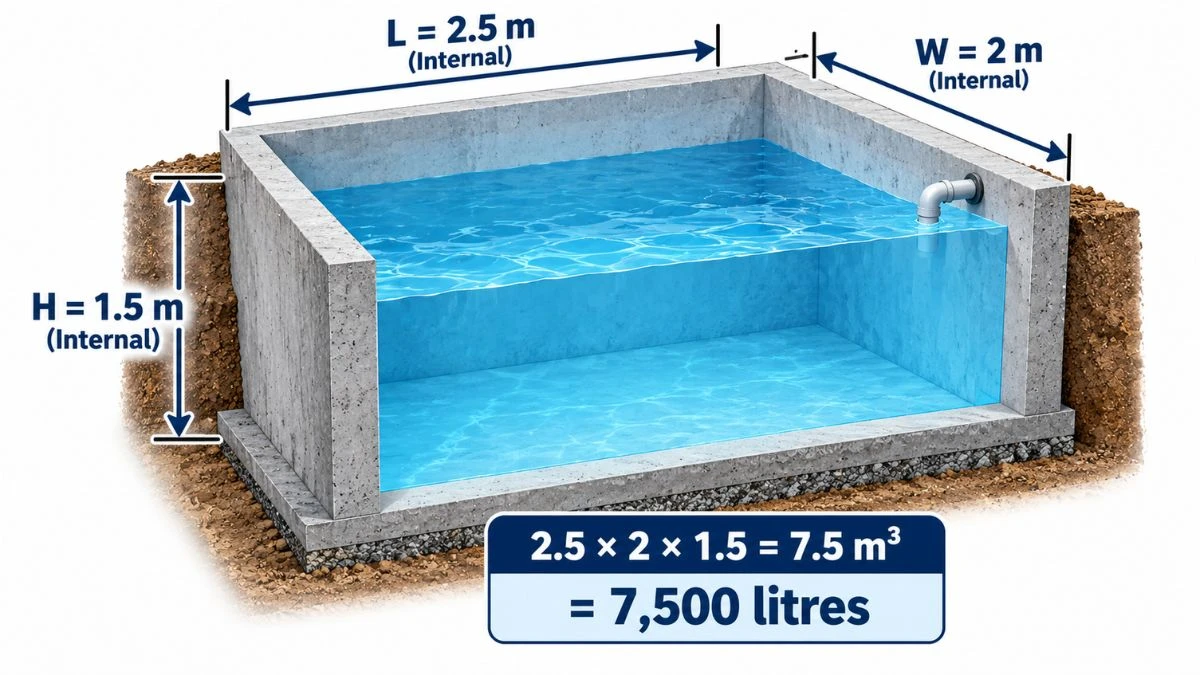
An underground sump has internal dimensions of 2.5 m length, 2 m width and 1.5 m depth.
- Volume = 2.5 × 2 × 1.5 = 7.5 m³
- Litres = 7.5 × 1000 = 7,500 litres
Same formula in feet
Many contractors still measure in feet. Take a tank that’s 6 ft × 4 ft × 4 ft.
- Volume = 6 × 4 × 4 = 96 ft³
- Litres = 96 × 28.317 = about 2,718 litres
Cylindrical Tank Calculation Formula
Round tanks are everywhere on Indian rooftops. The formula uses the circle’s area, so you need the radius.
Volume = π × radius² × height
Use π = 3.1416 for accurate work. The value 3.14 is fine for quick checks, while rounding π down to 3 can leave you about 4.5 percent short.
Watch out: radius is half the diameter
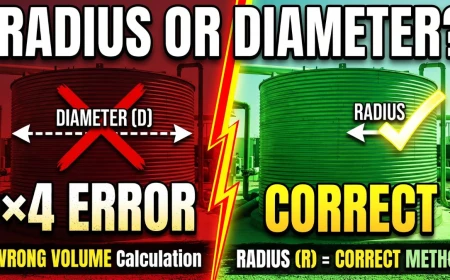
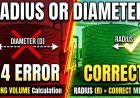
Tanks are usually sold by diameter. Divide it by 2 before you start. This single slip, using the diameter as the radius, makes your answer four times too big.
Worked example 2: round overhead tank
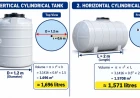
A cylindrical overhead tank has an internal diameter of 1.2 m and a height of 1.5 m.
- Radius = 1.2 ÷ 2 = 0.6 m
- Volume = 3.1416 × 0.6 × 0.6 × 1.5 = 1.696 m³
- Litres = about 1,696 litres
A shortcut using diameter
If you’d rather skip the halving, use this version: Litres = D² × H × 785.4, with D and H in metres.
Test it on the same tank: 1.2 × 1.2 × 1.5 × 785.4 = 2.16 × 785.4 = about 1,696 litres. Same answer, one step fewer.
Horizontal cylinder
Some diesel and water tanks lie on their side. The formula swaps height for length: Volume = π × r² × Length.
A horizontal tank with a 1 m diameter and 2 m length has a radius of 0.5 m. So 3.1416 × 0.25 × 2 = 1.571 m³, or about 1,571 litres when full.
A partly filled horizontal tank is a different story. The water level and the volume don’t rise in a straight line, so you can’t just take a percentage of the height. Use the manufacturer’s dip chart for those.
Cone-Bottom and L-Shaped Tank Volume
Not every tank is a plain box or drum. Two shapes come up often enough to cover here.
Cone-bottom tank
Treat it as two parts: a cylinder on top and a cone underneath. The cone formula is Volume = ⅓ × π × r² × h.
Take a tank with a 2 m diameter, a 1.5 m straight cylinder section and a 0.6 m cone below it. The radius is 1 m.
- Cylinder = 3.1416 × 1 × 1 × 1.5 = 4.712 m³
- Cone = ⅓ × 3.1416 × 1 × 1 × 0.6 = 0.628 m³
- Total = 5.341 m³, or about 5,341 litres
L-shaped or irregular tank
Break the shape into rectangles, calculate each one, then add them up. An L-shaped tank with a 3 m × 2 m section and a 2 m × 1.5 m section, both 1.5 m deep, works out like this.
- Section A = 3 × 2 × 1.5 = 9 m³
- Section B = 2 × 1.5 × 1.5 = 4.5 m³
- Total = 13.5 m³, or 13,500 litres
Actual Capacity vs Full Volume What Changes the Answer
The formula gives you the volume of the space. The water you can actually draw out is usually less. Three things explain the gap.
1. Internal vs external dimensions
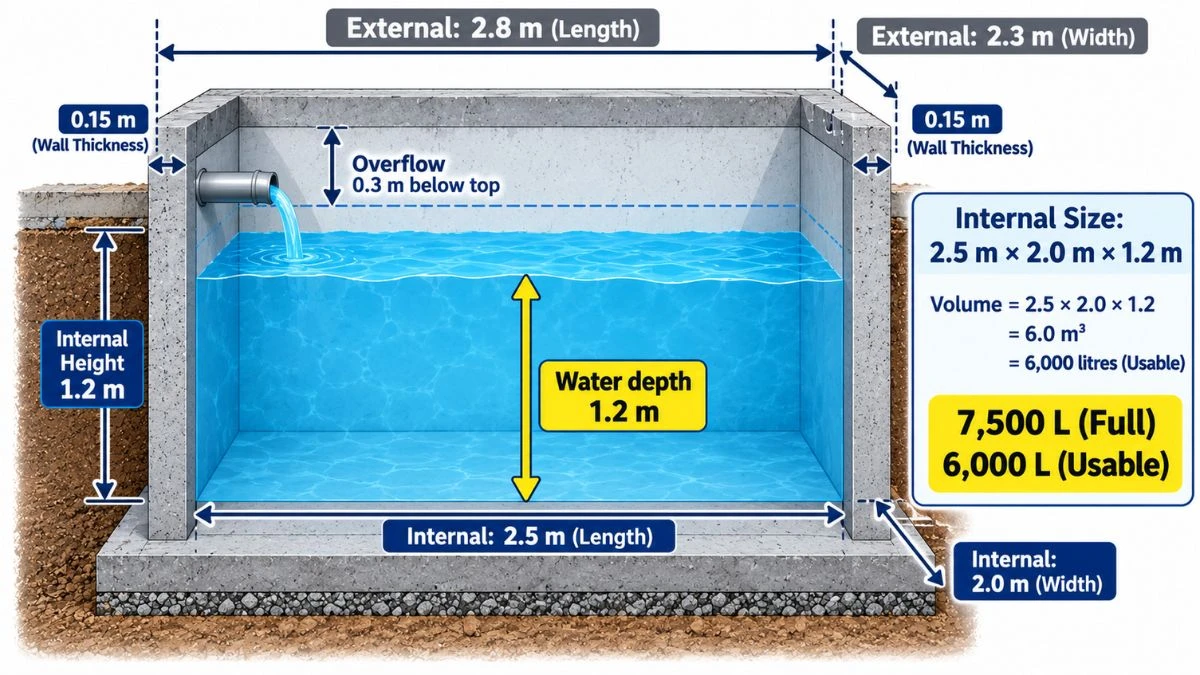
This is the biggest source of error on site. Say an RCC sump measures 2.8 m × 2.3 m on the outside, with 0.15 m thick walls on every side. The internal size is 2.5 m × 2 m.
- Using external size: 2.8 × 2.3 × 1.5 = 9.66 m³ = 9,660 litres
- Using internal size: 2.5 × 2 × 1.5 = 7.5 m³ = 7,500 litres
That’s an overestimate of 2,160 litres, close to 29 percent. Always measure inside the walls, or subtract the wall thickness from both ends of each dimension. Design drawings for liquid-retaining RCC structures follow IS 3370, so the internal sizes on those drawings are the numbers to use.
2. Overflow level and working depth
Water never sits right at the slab. The overflow pipe is set below the top, and the usable level is lower again. If the overflow sits 0.3 m below the top of our 1.5 m deep sump, the working depth is 1.2 m.
- Volume = 2.5 × 2 × 1.2 = 6 m³
- Litres = 6,000 litres, which is 80 percent of the full 7,500 litres
The same method works for any partly filled rectangular or vertical round tank. Replace the full height with the water depth.
3. Fittings and slope
Floor slopes toward the outlet, pipes and ladders all take up a little room. On a big tank the effect is small, but it’s one more reason to treat the calculated figure as the maximum, not the guaranteed amount.
How Big a Water Tank Do You Need ?
Once you can calculate a tank’s volume, the next question is how many litres you need. It depends on how many people use the water.
IS 1172:1993, the Indian code for basic water supply requirements, gives 150 to 200 litres per head per day as the general residential rate, which can drop to 135 litres for lower income and economically weaker section housing, with about 45 litres of it going to flushing. The National Building Code of India 2016 (Part 9, Plumbing Services) uses the same range and also allows 135 litres per head per day for lower-income housing. Most designers use 135 litres per person per day as a practical working figure.
Worked example 3: a family of 5
- Daily need = 5 × 135 = 675 litres
- Storage for two days = 675 × 2 = 1,350 litres
Now compare that with the round tank from Example 2. It holds about 1,696 litres, so it covers two days of use with some room left over.
Here’s a quick table for common family sizes, using 135 litres per person.
| Family size | Daily need (litres) | Two-day storage (litres) |
|---|---|---|
| 3 persons | 405 | 810 |
| 4 persons | 540 | 1,080 |
| 5 persons | 675 | 1,350 |
| 6 persons | 810 | 1,620 |
| 8 persons | 1,080 | 2,160 |
If your area has an unreliable supply, add another day of storage. Homes with gardens, washing machines running daily or guests staying regularly will also use more than 135 litres per head.
Water Tank Volume Calculator in Litres Ready Reckoner Tables
No time for the formula? These tables work like a water tank volume calculator in litres. All sizes are internal dimensions and assume the tank is filled to the brim, so reduce the figure if your overflow sits lower.
Rectangular tanks (dimensions in metres)
| Length × Width × Height | Volume (m³) | Capacity (litres) |
|---|---|---|
| 1.0 × 1.0 × 1.0 | 1 | 1,000 |
| 1.5 × 1.0 × 1.0 | 1.5 | 1,500 |
| 2.0 × 1.0 × 1.5 | 3 | 3,000 |
| 2.5 × 2.0 × 1.5 | 7.5 | 7,500 |
| 3.0 × 2.0 × 1.5 | 9 | 9,000 |
| 4.0 × 3.0 × 1.5 | 18 | 18,000 |
Vertical cylindrical tanks (dimensions in metres)
| Diameter × Height | Capacity (litres) |
|---|---|
| 1.0 × 1.0 | 785 |
| 1.2 × 1.5 | 1,696 |
| 1.5 × 1.5 | 2,651 |
| 2.0 × 2.0 | 6,283 |
| 2.5 × 2.0 | 9,817 |
The Weight of Water: Why Litres Matter for Structure
One litre of water weighs about 1 kg. So the 7,500 litre sump from Example 1 holds roughly 7,500 kg, or 7.5 tonnes, before you add the weight of the tank itself.
That number matters most for overhead tanks. The slab, beams and columns under a rooftop tank must carry this load safely. Structural design follows IS 456:2000 (Plain and Reinforced Concrete) along with the liquid-retaining rules in IS 3370, and it needs a qualified structural engineer. The volume formula gives you the starting load, but it doesn’t replace a design check.
Common Tank Calculation Mistakes
Most wrong answers come from a short list of slips.
- Forgetting the 1000. The answer stays in m³ and looks tiny. Always convert before you quote a capacity.
- Using diameter as radius. For round tanks, halve the diameter first.
- Mixing units. A length in metres and a height in centimetres gives nonsense. Convert everything first.
- Using external dimensions. Walls can add 25 to 30 percent to a small tank’s apparent size.
- Ignoring the overflow level. Full-height volume isn’t the water you can store.
- Rounding π too hard. Use 3.14 or 3.1416. Using 3 introduces an error of nearly 5 percent.
Conclusion
The tank calculation formula comes down to two lines. Rectangular tank: length × width × height. Round tank: π × radius² × height. Then apply the 1000 rule, multiplying cubic metres by 1000 and dividing cubic centimetres by 1000 to get litres.
Measure inside the walls, check your units and note the working water level. Do that and your numbers will match what the tank actually holds, whether it’s a 7,500 litre sump or a 1,696 litre overhead tank. Bookmark the ready reckoner tables above for quick checks on site.
Frequently Asked Questions

Ar. Prince Badaik Is A Civil Engineering And Construction Content Creator At Civil Cost. He Shares Practical Information About Construction, Building Materials, Quantity Estimation, Costing, And Structural Engineering In A Simple And Easy To Understand Way.







Comments (0)